Naval Group: saving weeks of machining on a one-off part
Submarine blade machining. A cycle running several months, a single part of very high value, and no room for error. Lesly detects spindle-head phase drift before it damages the material.
- Customer : Naval Group — naval defence manufacturing
- Equipment : AM75 machine tool, TUPC spindle head
- Operation : Submarine blade machining — one-off part
- Constraint : Multi-month cycle, temperatures up to 3,200 °C
- Module : @MachineHealth + KM0
The field challenge
A submarine blade is machined over several months, as a one-off, in a material where every chip is irreplaceable. Scrap is not an accounting loss: it is a strategic delay. The TUPC spindle head is exposed to phase drift, which first shows up as measurement error, then as quality loss, then as rework — and by then the material is already cut.
The thermal context rules out classic physical monitoring: temperatures reach 3,200 °C at the cutting point. Adding instrumentation was never an option.
- 1.21% — TUPC_A — detected drift
- 28.3% — TUPC_POSITION_U
- 68.2% — TUPC_POSITION_V
- 3,200 °C — Cutting-point temperature
What Lesly saw
The KM0 engine characterised the TUPC head’s normal signature, then measured the gap continuously. A-axis drift comes out at 1.21%, with U and V positions named as the most influential variables — 28.3% and 68.2% contribution. The cause is named, the component located, and the intervention can be scheduled between two passes instead of suffered.
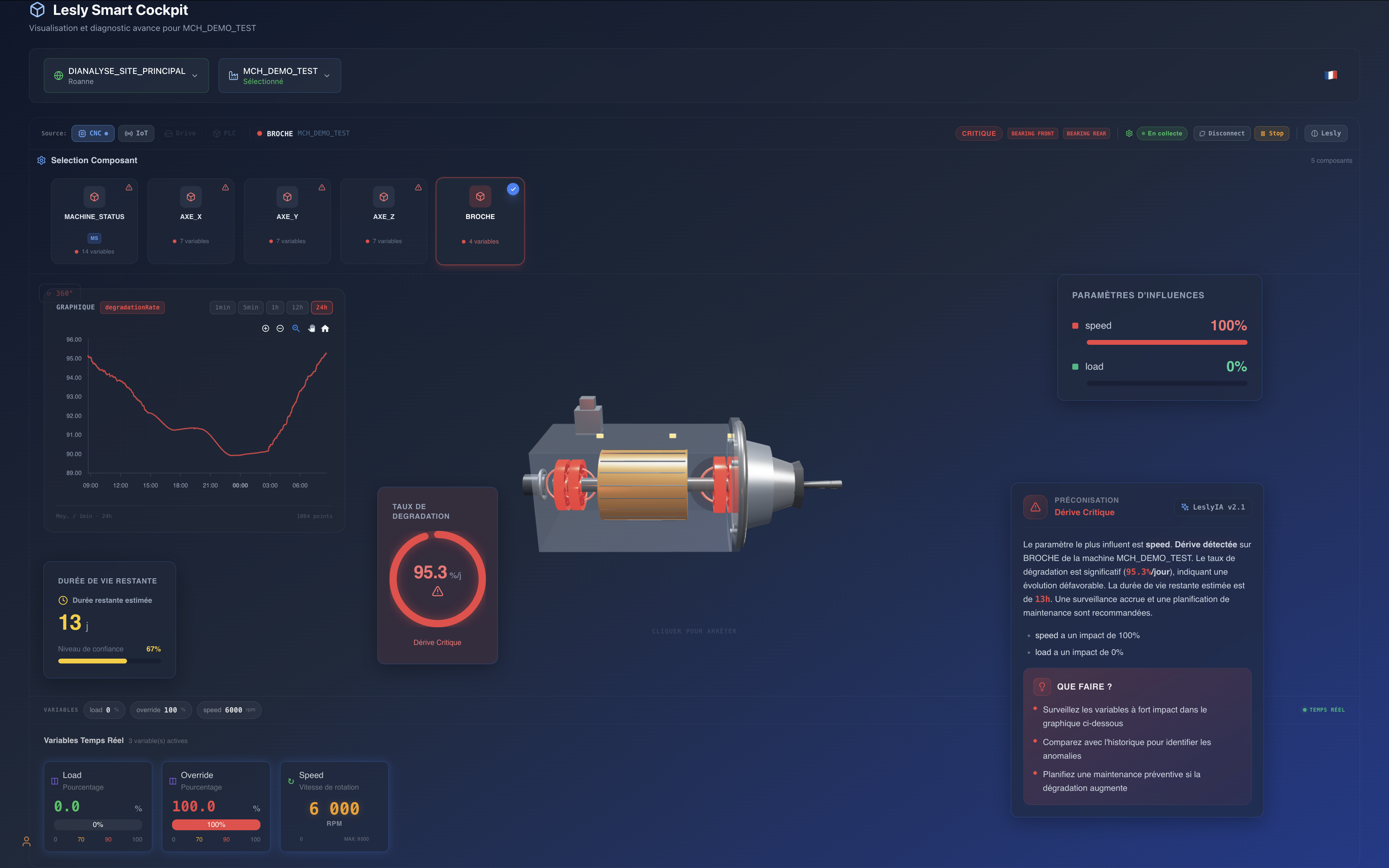
Detecting drift before it damages the material means saving weeks of machining and avoiding strategic scrap.
Decisive argument — ref. DAS-DIA-160626-UC-001
No sensor added
Detection relies on native numerical-control data — further instrumentation is impossible at 3,200 °C.
Drift before defect
Phase drift is flagged at the statistical-deviation stage, before measurement error and therefore before rework.
Measured spindle ROI
+20 to 30% availability and +15 to 20% lifetime on the monitored component.
Does your fleet involve very high-value parts and long cycles? That is precisely where early detection is counted in weeks saved.