PCI Machining: a Ø3 mm drill breakage seen where power monitoring is blind
A French manufacturer of high-performance machining centres, in Saint-Étienne. A 3 mm drill’s energy signature sits below the detection threshold of power-monitoring systems. KM0 saw it using numerical-control data alone.
- Customer : PCI Machining — Saint-Étienne, France
- Business : High-performance machining centres
- Operation : Precision drilling, Ø3 mm drill
- Data : Torques, axis currents, position — no added sensor
- Module : @MachineHealth KM0
The market’s physical limit
Power-monitoring systems — the Digitalway kind — rest on a simple principle: an incident consumes energy, so it can be seen. Except that a 3 mm diameter drill consumes so little that its energy signature falls below the detection threshold. The breakage exists and is measurable in theory, but it is physically invisible to the instrument. This is not a tuning problem: it is a limit of the method.
Power monitoring
Digitalway type — physical limit
-
A Ø3 mm drill’s energy signature falls below the detection threshold
-
Global measurement: the individual event vanishes into the average
-
Breakage NOT detected
Lesly · @MachineHealth KM0
Unsupervised AI on NC data
-
Native numerical-control data — torques, axis currents, position
-
Higher granularity, micro-scale detection
-
No added sensor, no instrumentation cost
-
Breakage DETECTED
What KM0 reads instead
Rather than measuring overall power, KM0 uses the native data of the numerical control: torques, axis currents, position. Granularity is far higher, and the departure from the normal signature shows at micro scale — exactly where the event occurs. The breakage was detected. With no added sensor and no instrumentation cost.
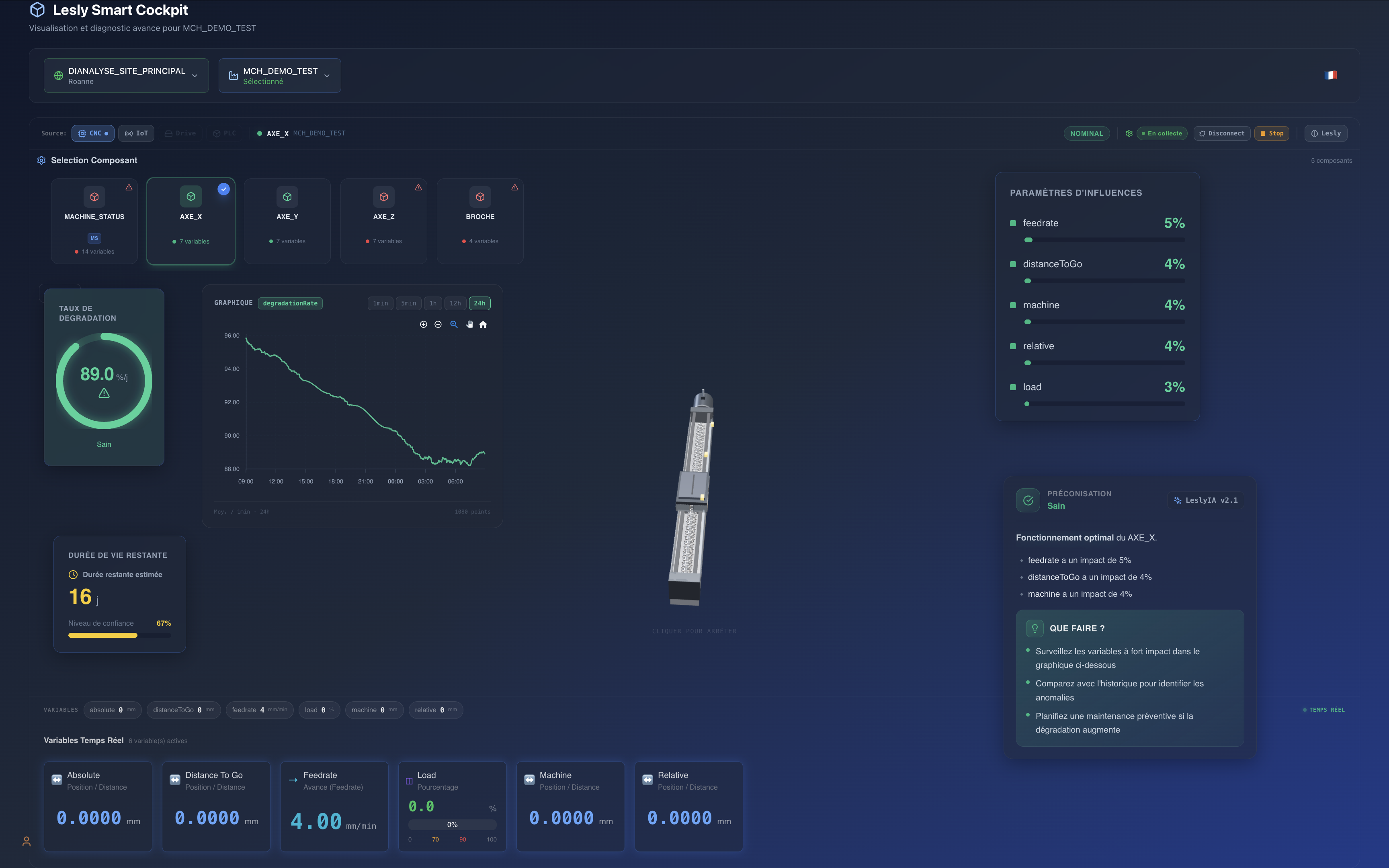
When power monitoring reaches its physical limit, KM0 AI takes over on numerical-control data alone — higher granularity, micro-scale event detection, no instrumentation cost.
Technical relevance — ref. DAS-DIA-160626-UC-001
Where the market stops
This case does not compare two settings but two methods — and one of them structurally cannot see the event.
Zero instrumentation
The data already exists in the numerical control. Nothing to install, wire or maintain.
Micro scale
Detection reaches the individual event, not the cycle average.
Machining small diameters and your current systems miss the breakage? This is KM0’s textbook case. Let us test it on one of your machines.