Disappointed by predictive maintenance? You had the wrong AI.
Supervised solutions demand months of labelled data, a data scientist and a failure history nobody actually owns. Lesly Machine Health builds its models on day one, on your machines, with none of that.
-
+40% — Machine availability
-
+30% — Component lifetime
-
−20% — Production scrap
-
< 6 months — Return on investment
-
Module : Lesly Machine Health — reliability
-
What is monitored : Spindles, axes, ball screws, linear bearings, bearings
-
Who it is for : Maintenance, methods, production, industrial management
-
Engine : KM0 — self-learning unsupervised AI, made in France
-
Licence unit : Annual subscription per monitored component
-
Processing : 100% edge — LeslyBox or industrial PC, on your site
The problem was never the data. It is what you are asked for before you can start.
Every supervised predictive-maintenance product sets the same entry condition: bring us months of data, labelled failure by failure. Those labels do not exist. A plant that maintains its machines properly does not collect breakdowns — and the ones it suffered were never instrumented. You are effectively invited to break your machines in order to learn how to watch them.
KM0 unsupervised AI removes that deadlock. Lesly does not learn what a failure looks like: it learns what normal operation looks like on your component, on your machine, under your production conditions. Any departure from that reference becomes a signal — including faults nobody has named yet.
What the others require
Supervised market solutions
-
Months of data labelled by fault type
-
A data scientist to analyse and build the models
-
A failure history nobody actually owns
-
Dependency on a proprietary cloud
-
Detection limited to already-known faults
KM0 — Kilometre Zero
Self-learning unsupervised AI · Made in France
-
Local deployment in a few clicks, no months of waiting
-
No historical data — the reference comes from normal operation
-
Detection of unknown and emerging faults
-
Continuous self-learning that capitalises knowledge
-
Built for shop-floor teams, in production and maintenance
Kilometre Zero: the reference is built while running
The first days of collection establish each component’s fingerprint: position, load, feedrate and speed signatures. That is KM0. From there the engine continuously measures the gap to that fingerprint and turns it into two figures your teams read without training: a daily degradation rate and a remaining useful life — with its confidence level on screen, because a prediction without a confidence interval is not a prediction.
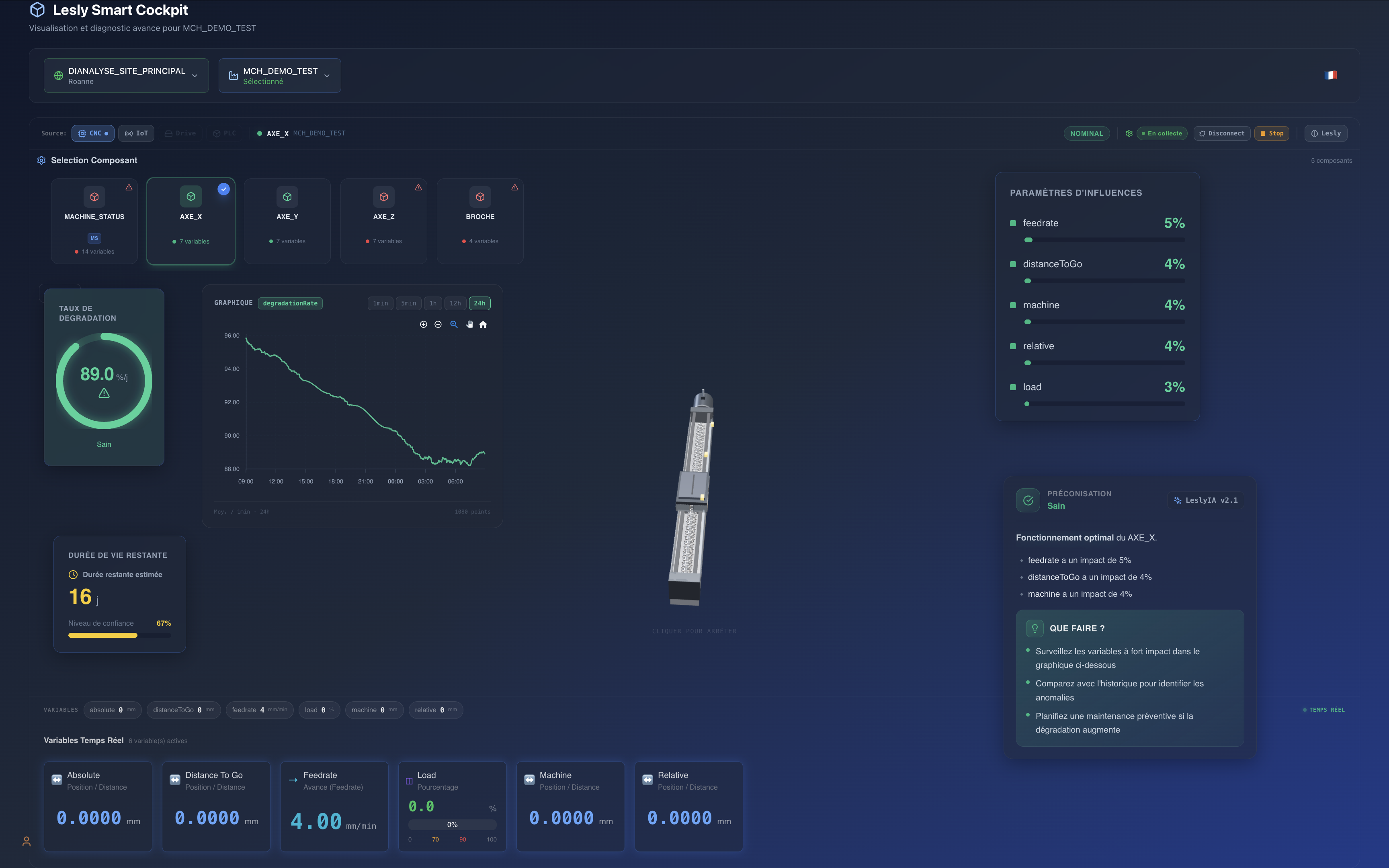
The 3D digital twin: the faulty part, named
A degradation rate, however accurate, does not tell the technician where to put the wrench. Lesly projects health onto the 3D model of the monitored component: ball screws, linear bearings, front and rear spindle bearings. The risk zone lights up. Diagnosis stops being an investigation and MTTR falls.
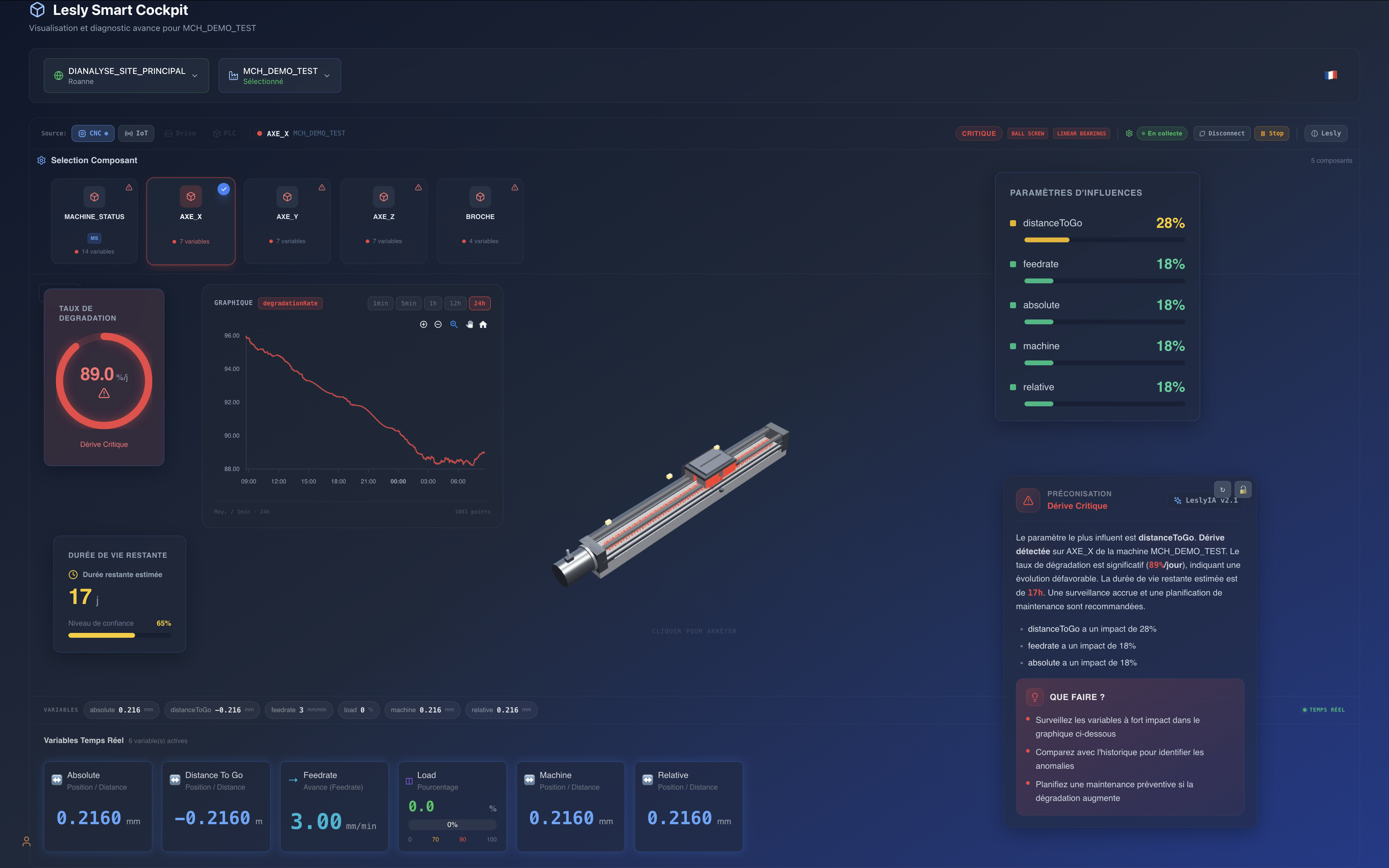
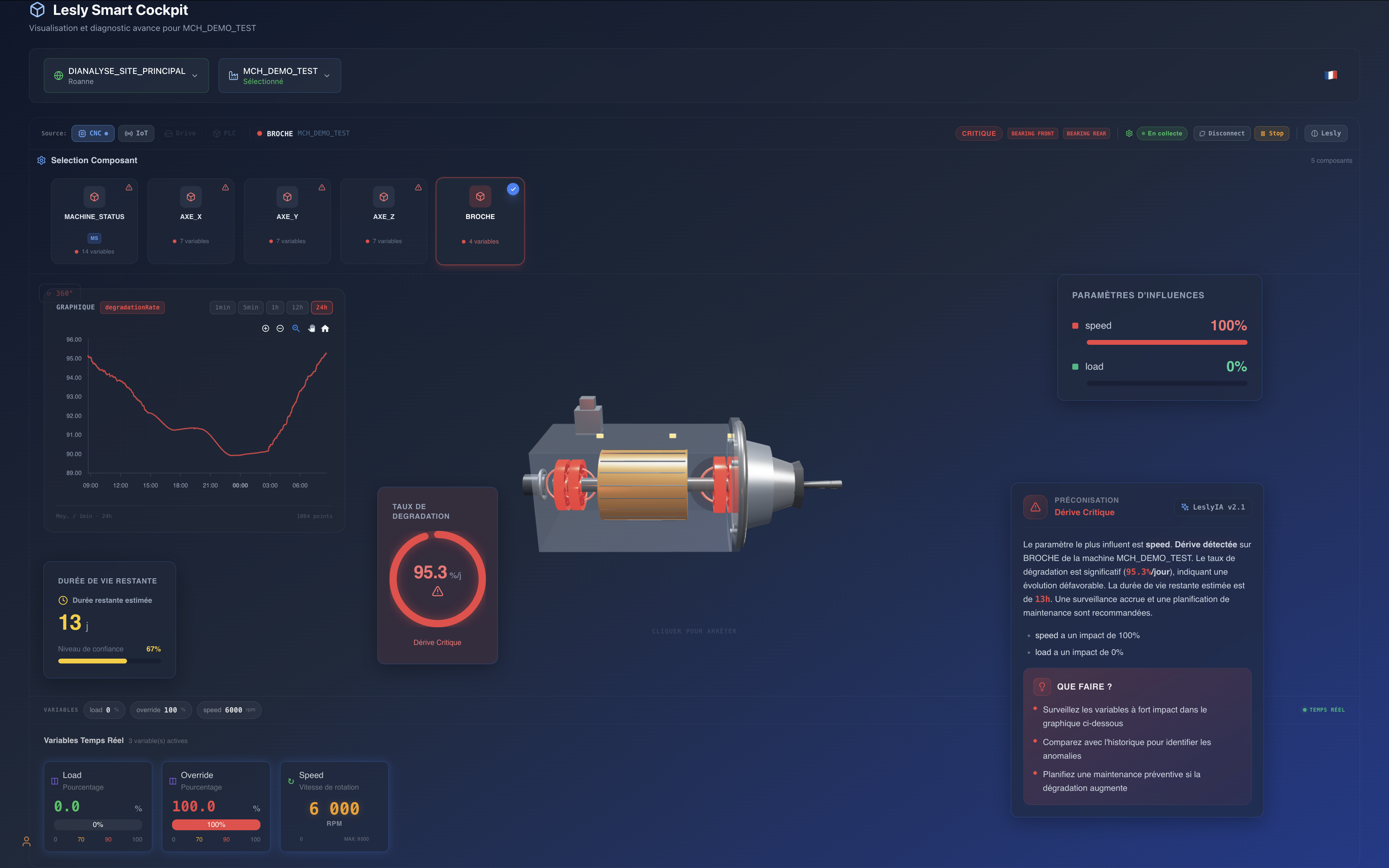
The copilot answers in plain language, not in curves
Every alert carries a "What should I do?" block written by LeslyIA: influential variables ranked by impact, probable cause, corrective action and recommended lead time. Operators ask out loud — "why did spindle B2 degrade?" — and get a structured root-cause analysis in seconds. Expertise stops being the privilege of two people on the shop floor.
- KM0 unsupervised AI — no labelled dataset, no data scientist
- Detects unknown and emerging faults, not just known thresholds
- Degradation rate and RUL with confidence level, per component
- 3D digital twin per part: spindle, ball screw, bearings, axes
- Conversational copilot with a prioritised preventive plan
- Continuous self-learning — knowledge is capitalised, not lost
No history required
The reference comes from observed normal operation, not from a failure catalogue you do not have.
Unknown faults too
A threshold system only sees what was described to it. KM0 flags any departure, including emerging degradations never met before.
No data scientist
No model to train, no data project to fund. Shop-floor teams run the platform themselves.
The part is named
The 3D twin locates the risk zone: the technician knows where to work before opening the cover. MTTR drops.
Expertise is passed on
The copilot states the diagnosis in plain language. Know-how stops leaving with retirements.
Your data stays with you
Full OT/IT isolation, no imposed outbound flow, no vendor lock-in. What you build is yours.
Your data never leaves the plant
All processing runs locally, on LeslyBox or an industrial PC, inside your site. Full OT/IT isolation, no imposed outbound flow, no added cyber exposure. The cloud manages licences and distributes intelligence — it never hosts your production. What you paid for and built is yours, for life, with zero vendor lock-in.
Machine data stays in the plant. That is industrial sovereignty, not dependency.
Lesly architecture principle
"Try Lesly" programme — 90 days of evaluation on your machines, an automated ROI report at the end, and onboarding fully credited against your first order.